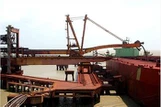
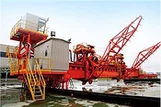
As a supplier of Continuous Ship Unloaders, I've witnessed firsthand the challenges and intricacies involved in handling materials within holds of complex shapes. In this blog, I'll delve into the methods and technologies we employ to ensure efficient and effective material handling in such scenarios.
Understanding the Challenges of Complex - Shaped Holds
Ship holds come in a variety of shapes, and complex - shaped ones present unique difficulties. These can include irregular contours, sloping floors, and compartments with varying depths. Such shapes can cause uneven distribution of materials, making it hard to access all areas for unloading. Additionally, the presence of obstacles or protrusions within the hold can impede the movement of the unloader.
Key Features of Continuous Ship Unloaders for Complex - Shaped Holds
Flexibility in Design
Our Continuous Ship Unloaders are designed with a high degree of flexibility. They can be adjusted to adapt to different hold shapes. For example, the boom of the unloader can be articulated, allowing it to reach into corners and areas with restricted access. This flexibility enables the unloader to follow the contours of the hold, ensuring that materials are removed from all parts of the space.
Advanced Control Systems
The control systems of our unloaders play a crucial role in handling complex - shaped holds. These systems use sensors and real - time monitoring to detect the position and shape of the hold. They can then adjust the operation of the unloader accordingly. For instance, if the hold has a sloping floor, the control system can regulate the speed and angle of the unloading mechanism to prevent materials from accumulating in one area.


Different Types of Continuous Ship Unloaders and Their Adaptability
Buried Scraper Type Ship Unloader
The Buried Scraper Type Ship Unloader is well - suited for complex - shaped holds. Its scraper chain system can work effectively even in holds with irregular surfaces. The scrapers can move through the material, pushing it towards the discharge point. The design of the buried scraper allows it to operate close to the bottom of the hold, ensuring that most of the materials are removed.
Bucket Wheel Ship Unloader
The Bucket Wheel Ship Unloader is another option. Its rotating bucket wheel can pick up materials from different depths and angles. In a complex - shaped hold, the bucket wheel can be adjusted to reach into compartments and around obstacles. The continuous rotation of the wheel ensures a steady flow of materials during the unloading process.
Fixed Screw Ship Unloader
The Fixed Screw Ship Unloader is also capable of handling complex - shaped holds. The screw conveyor can be positioned at different angles to match the shape of the hold. It can efficiently transport materials from the hold to the discharge point, even in areas with limited space.
Step - by - Step Process of Handling Materials in a Complex - Shaped Hold
Initial Assessment
Before starting the unloading process, a detailed assessment of the hold's shape is carried out. This can involve using 3D scanning technology to create a digital model of the hold. The model helps in planning the unloading strategy, such as determining the best starting point and the path for the unloader.
Positioning the Unloader
Once the assessment is complete, the unloader is positioned at the optimal location. This may require adjusting the boom, the conveyor, and other components to align with the shape of the hold. The goal is to ensure that the unloading mechanism can reach all areas of the hold.
Unloading Operation
During the unloading operation, the control system continuously monitors the position of the unloader and the amount of material being removed. As the unloader moves through the hold, it adjusts its operation based on the shape of the hold. For example, if it encounters a narrow compartment, it may slow down the speed of the unloading mechanism to ensure efficient removal of materials.
Final Cleaning
After most of the materials have been removed, a final cleaning process is carried out. This involves using the unloader to access the remaining materials in hard - to - reach areas, such as corners and under obstructions. The goal is to leave the hold as clean as possible.
Advantages of Using Our Continuous Ship Unloaders in Complex - Shaped Holds
High Efficiency
Our unloaders are designed to maximize efficiency in complex - shaped holds. The advanced control systems and flexible designs allow for quick and thorough unloading, reducing the time required for the operation.
Reduced Labor Costs
Since the unloaders are automated and can adapt to different hold shapes, they require less manual intervention. This leads to a significant reduction in labor costs compared to traditional unloading methods.
Minimal Material Loss
The precise operation of our unloaders ensures that most of the materials are removed from the hold. This reduces material loss, which is not only cost - effective but also environmentally friendly.
Conclusion
Handling materials in a hold with a complex shape is a challenging task, but our Continuous Ship Unloaders are up to the challenge. With their flexible designs, advanced control systems, and various types of unloading mechanisms, they can efficiently and effectively remove materials from even the most irregularly - shaped holds.
If you're in the market for a reliable and efficient Continuous Ship Unloader for your complex - shaped holds, we'd love to have a discussion with you. Contact us to start a procurement conversation and find the best solution for your specific needs.
References
- "Ship Unloading Technology: Principles and Applications", Maritime Engineering Journal, 2020
- "Advanced Control Systems for Continuous Ship Unloaders", Automation in Shipping Research, 2021