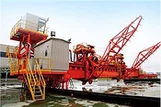
So, you're probably wondering how the discontinuous ship unloader is powered. Well, let me break it down for you as a supplier of Discontinuous Ship Unloaders.
First off, discontinuous ship unloaders come in different types, like the Grab Bucket Gantry Crane, Grab Type Ship Unloader, and Query-side Container Crane. Each of these has its own power - supply nuances, but we'll cover the general principles.
Electrical Power - The Mainstay
Most modern discontinuous ship unloaders are powered by electricity. It's a reliable and clean source of power that can be easily regulated and controlled. There are a couple of ways the electricity gets to the unloader:
Shore - Side Power Supply
One common method is to connect the ship unloader directly to the shore - side electrical grid. This is a straightforward and cost - effective solution, especially in well - developed ports. The connection is usually made through thick cables that are designed to handle high - voltage electricity. These cables are hooked up to the unloader's electrical system at one end and to the shore - side power distribution unit at the other.
The advantage of shore - side power is that it provides a stable and continuous supply of electricity. The port authorities usually take care of maintaining and upgrading the electrical infrastructure, so the unloader operators don't have to worry too much about power outages. However, the drawback is that the unloader is limited to operating within the reach of the shore - side cables.
On - Board Generators
In some cases, especially for smaller discontinuous ship unloaders or those operating in remote locations, on - board generators are used. These generators can run on diesel, natural gas, or other fuels. The advantage of on - board generators is that they offer more flexibility. The unloader can move around more freely without being restricted by the length of shore - side cables.
On - the - flip side, generators need regular maintenance. You have to keep them fueled up, and they can be noisy and produce emissions. But with modern technology, many of these generators are becoming more efficient and eco - friendly.
Hydraulic Systems in Power Transmission
Apart from electricity, hydraulic systems play a crucial role in powering discontinuous ship unloaders, especially when it comes to moving heavy parts of the machinery.
How Hydraulic Power Works
Hydraulic systems use a liquid, usually oil, to transmit power. A hydraulic pump, which is powered by an electric motor or an engine, pressurizes the oil. This pressurized oil is then sent through a series of pipes and valves to different hydraulic cylinders and motors on the ship unloader.
For example, in a grab - type ship unloader, the hydraulic cylinders are used to open and close the grab bucket. When the oil is pumped into the cylinder, it pushes a piston, which in turn moves the grab arms. Hydraulic systems are great because they can generate a large amount of force in a relatively small space. They're also very precise, allowing for accurate control of the movement of the unloader's components.
Safety Considerations in Power Supply
Safety is a top priority when it comes to powering discontinuous ship unloaders.
Electrical Safety
When dealing with high - voltage electricity, proper insulation is essential. All electrical components of the unloader are enclosed in protective casings to prevent accidental contact. Additionally, there are circuit breakers and grounding systems in place. Circuit breakers automatically cut off the power supply in case of an electrical fault, like a short circuit or an overload. Grounding helps to direct any stray electrical currents safely into the ground.
Hydraulic Safety
In hydraulic systems, the pressure in the pipes and cylinders needs to be carefully monitored. Pressure relief valves are installed to prevent the pressure from getting too high and causing a rupture. Regular inspections of the hydraulic hoses and seals are also carried out to ensure there are no leaks. A hydraulic fluid leak can be not only a waste of resources but also a safety hazard, as the oil can be slippery and flammable in some cases.
Power Management for Efficiency
Efficiency is key in the operation of discontinuous ship unloaders. To reduce power consumption and operating costs, advanced power management systems are used.
Smart Control Systems
These systems use sensors and computer algorithms to optimize the power consumption of the unloader. For example, the control system can detect when the grab bucket is empty and reduce the power supplied to the motors that move it. It can also adjust the speed of the conveyor belts based on the amount of cargo being unloaded.
Energy Recovery
Some modern discontinuous ship unloaders are equipped with energy - recovery systems. When the grab bucket is lowered, for instance, the energy generated by its downward movement can be captured and converted back into electricity. This recovered energy can then be used to power other parts of the unloader, improving overall energy efficiency.
As a supplier of Discontinuous Ship Unloaders, we understand the importance of a reliable and efficient power supply for these machines. We offer a wide range of options to meet the specific needs of our customers, whether it's shore - side power, on - board generators, or advanced hydraulic systems.
If you're in the market for a discontinuous ship unloader, or you're looking to upgrade your existing equipment, we'd love to have a chat with you. We can help you choose the right power - supply solution for your operation and ensure that your new unloader runs smoothly and efficiently. Don't hesitate to reach out for a detailed discussion about your requirements.
References


- Crane Handbook: Operation and Maintenance. Industrial Publication, 2019.
- Principles of Hydraulic Systems in Heavy Machinery. Mechanical Engineering Press, 2020.
- Electrical Power Distribution in Port Facilities. Maritime Technology Journal, 2021.