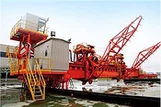
In the bustling world of bulk material handling, the fixed screw ship unloader stands as a stalwart workhorse, efficiently transferring various bulk materials from ships to storage facilities. However, in an industry that constantly demands higher efficiency, adaptability, and cost - effectiveness, enhancing the operation flexibility of fixed screw ship unloaders has become a pressing concern. As a leading supplier of fixed screw ship unloaders, I am eager to share some insights on how to achieve this goal.
Understanding the Current Challenges
Before delving into solutions, it is essential to understand the challenges that limit the operation flexibility of fixed screw ship unloaders. Firstly, the fixed nature of these unloaders restricts their ability to adapt to different ship sizes and loading configurations. Larger ships may require a wider reach and greater height adjustment, while smaller vessels may need more precise positioning to ensure efficient unloading.
Secondly, the type of bulk material being handled can pose challenges. Different materials have varying physical properties, such as density, moisture content, and particle size. Some materials may be prone to clogging, while others may require specific handling techniques to prevent damage.
Thirdly, environmental factors, such as wind, waves, and tide levels, can significantly impact the operation of fixed screw ship unloaders. High winds can affect the stability of the equipment, while changing tide levels may require adjustments to the height of the unloader to maintain proper contact with the cargo.
Technological Innovations for Enhanced Flexibility
Advanced Control Systems
One of the most effective ways to improve the operation flexibility of fixed screw ship unloaders is through the implementation of advanced control systems. These systems use sensors and actuators to monitor and adjust the operation of the unloader in real - time. For example, sensors can detect the position of the ship, the level of the cargo, and the condition of the unloading process. Based on this information, the control system can automatically adjust the speed, angle, and height of the screw conveyor to optimize the unloading efficiency.


Advanced control systems also enable remote operation and monitoring. This means that operators can control the unloader from a central control room, allowing for greater flexibility and safety. In addition, remote monitoring allows for proactive maintenance, as potential issues can be detected and addressed before they cause significant downtime.
Modular Design
Another approach to enhancing flexibility is through the use of modular design. A modular fixed screw ship unloader consists of standardized components that can be easily assembled, disassembled, and reconfigured. This allows for quick adaptation to different ship sizes and cargo requirements. For example, additional sections of the screw conveyor can be added or removed to increase or decrease the reach of the unloader.
Modular design also simplifies maintenance and repair. Instead of replacing an entire piece of equipment, only the faulty module needs to be replaced. This reduces downtime and lowers the overall cost of ownership.
Adjustable Boom Jib
The Boom Jib is a critical component of the fixed screw ship unloader, as it determines the reach and height of the unloading operation. An adjustable boom jib can significantly improve the flexibility of the unloader. It can be extended or retracted to reach different parts of the ship's hold, and it can be raised or lowered to accommodate different tide levels and ship heights.
Some advanced boom jibs are also equipped with articulation joints, which allow for greater maneuverability. This enables the unloader to access hard - to - reach areas of the hold, improving the overall unloading efficiency.
Material - Specific Solutions
Customized Screw Conveyors
To handle different types of bulk materials, customized screw conveyors can be designed. For materials that are prone to clogging, such as wet sand or sticky powders, screw conveyors with special geometries and surface treatments can be used. These conveyors are designed to prevent material buildup and ensure smooth flow.
For abrasive materials, such as coal or ore, screw conveyors with wear - resistant liners can be installed. This extends the service life of the conveyor and reduces maintenance costs.
Material Handling Accessories
In addition to customized screw conveyors, various material handling accessories can be used to improve the flexibility of the fixed screw ship unloader. For example, vibrating devices can be installed on the screw conveyor to help loosen and flow the material. Dust suppression systems can be added to control dust emissions, especially when handling fine - grained materials.
Environmental Adaptation
Wind - Resistance Design
To mitigate the impact of high winds on the operation of fixed screw ship unloaders, wind - resistance design features can be incorporated. This includes the use of aerodynamic shapes for the boom jib and other exposed components. In addition, stability sensors can be installed to detect and compensate for the effects of wind on the equipment.
Tide - Level Compensation
To handle changing tide levels, tide - level compensation systems can be implemented. These systems use sensors to monitor the water level and automatically adjust the height of the unloader to maintain proper contact with the cargo. This ensures continuous and efficient unloading, regardless of the tide conditions.
Training and Operator Skills
Even with the most advanced technology, the operation flexibility of fixed screw ship unloaders ultimately depends on the skills and knowledge of the operators. Therefore, comprehensive training programs should be provided to operators to ensure they are familiar with the equipment and its capabilities.
Training should cover topics such as equipment operation, maintenance, troubleshooting, and safety procedures. In addition, ongoing training and refresher courses should be offered to keep operators up - to - date with the latest technological advancements and industry best practices.
Conclusion
Improving the operation flexibility of fixed screw ship unloaders is a multi - faceted challenge that requires a combination of technological innovation, material - specific solutions, environmental adaptation, and operator training. As a supplier of fixed screw ship unloaders, we are committed to developing and implementing these solutions to meet the evolving needs of our customers.
If you are in the market for a fixed screw ship unloader or are looking to upgrade your existing equipment to improve its operation flexibility, we invite you to contact us for a detailed discussion. Our team of experts will work with you to understand your specific requirements and provide customized solutions that meet your needs.
References
- Smith, J. (2020). Advances in Bulk Material Handling Technology. Journal of Material Handling Science, 15(2), 45 - 56.
- Johnson, A. (2019). The Impact of Environmental Factors on Ship Unloading Operations. Maritime Engineering Review, 22(3), 78 - 85.
- Brown, C. (2021). Modular Design in Industrial Equipment: A Case Study of Ship Unloaders. Industrial Design Journal, 30(1), 23 - 32.