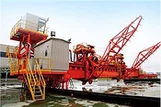
A Mobile Bulk Ship Loader is a crucial piece of equipment in the shipping and bulk material handling industry. As a supplier of Mobile Bulk Ship Loaders, I am well - versed in the main components that make up these sophisticated machines. Understanding these components is essential for anyone involved in bulk material loading operations, whether they are operators, planners, or those considering purchasing a Mobile Bulk Ship Loader.
1. Conveyor System
The conveyor system is the heart of a Mobile Bulk Ship Loader. It is responsible for transporting the bulk materials from the storage area to the ship's hold. There are different types of conveyors used in Mobile Bulk Ship Loaders, including belt conveyors and screw conveyors.
Belt conveyors are the most common type. They consist of a continuous belt that moves over a series of rollers. The belt is made of durable materials such as rubber or PVC, which can withstand the abrasion and impact of the bulk materials. The belt is driven by a motor, and the speed of the belt can be adjusted according to the loading requirements. The width and length of the belt conveyor can also be customized based on the capacity and the distance of material transportation.
Screw conveyors, on the other hand, use a rotating screw to move the bulk materials. They are often used for handling powdery or granular materials. Screw conveyors are more compact than belt conveyors and can be used in situations where space is limited. However, they are not as efficient as belt conveyors for handling large volumes of materials.
The conveyor system also includes transfer points, where the materials are transferred from one conveyor to another or from the conveyor to the ship's hold. These transfer points need to be designed carefully to minimize material spillage and dust generation.
2. Boom Structure
The boom is a key component of a Mobile Bulk Ship Loader. It is a long, extendable arm that can be raised, lowered, and slewed (rotated horizontally). The boom is used to position the discharge end of the conveyor system over the ship's hold.


The boom structure is typically made of steel to ensure strength and durability. It is designed to withstand the weight of the conveyor system and the bulk materials being transported. The boom can be extended or retracted to reach different parts of the ship's hold. This flexibility allows the Mobile Bulk Ship Loader to load materials into ships of different sizes and configurations.
The slewing mechanism of the boom is usually powered by hydraulic or electric motors. It enables the boom to rotate 360 degrees, providing full coverage of the ship's deck. The raising and lowering of the boom are also controlled by hydraulic cylinders, which allow for precise positioning of the discharge end of the conveyor.
3. Mobile Chassis
As the name suggests, a Mobile Bulk Ship Loader is designed to be mobile. The mobile chassis provides the mobility of the loader. It is typically mounted on wheels or tracks.
Wheeled chassis are more common for Mobile Bulk Ship Loaders that operate on paved surfaces. They offer good maneuverability and can be easily transported from one location to another. The wheels are usually powered by an engine or an electric motor, and the steering system allows the loader to be driven in different directions.
Tracked chassis, on the other hand, are used for Mobile Bulk Ship Loaders that need to operate on uneven or soft ground. Tracks provide better traction and stability, especially in challenging terrains. They can distribute the weight of the loader more evenly, reducing the risk of sinking or getting stuck.
The mobile chassis also includes a suspension system to absorb shocks and vibrations during movement. This helps to protect the components of the loader and ensure a smooth operation.
4. Dust Suppression System
Dust generation is a major concern in bulk material handling operations. A dust suppression system is an important component of a Mobile Bulk Ship Loader to minimize the environmental impact and protect the health of the operators.
There are several types of dust suppression systems used in Mobile Bulk Ship Loaders. One common method is the use of water sprays. Water is sprayed onto the bulk materials at the transfer points and the discharge end of the conveyor. The water helps to wet the materials and prevent the dust from becoming airborne.
Another type of dust suppression system is the use of dust collectors. Dust collectors are installed at the transfer points and other areas where dust is likely to be generated. They work by capturing the dust particles and separating them from the air. The collected dust can then be disposed of safely.
Some Mobile Bulk Ship Loaders also use enclosed conveyor systems to prevent dust from escaping. The conveyor is enclosed in a housing, and the air inside the housing is filtered to remove the dust particles.
5. Control System
The control system of a Mobile Bulk Ship Loader is responsible for coordinating the operation of all the components. It allows the operator to control the movement of the conveyor system, the boom, the mobile chassis, and the dust suppression system.
The control system can be either manual or automated. In a manual control system, the operator uses levers, buttons, or joysticks to control the different functions of the loader. This type of control system is suitable for small - scale operations or when the operator needs to have direct control over the loading process.
In an automated control system, the loader is programmed to perform specific tasks based on pre - set parameters. The automated control system can improve the efficiency and accuracy of the loading process. It can also reduce the labor intensity and the risk of human error. The control system is usually connected to sensors and monitors that provide real - time information about the operation of the loader, such as the position of the boom, the speed of the conveyor, and the dust level.
6. Power Supply
A Mobile Bulk Ship Loader requires a reliable power supply to operate. The power supply can be either electric or diesel - powered.
Electric - powered Mobile Bulk Ship Loaders are more environmentally friendly and have lower operating costs. They are usually connected to the local power grid through a cable. However, they are limited by the availability of the power grid and the length of the cable.
Diesel - powered Mobile Bulk Ship Loaders, on the other hand, are more independent and can operate in remote areas where there is no access to the power grid. They are powered by a diesel engine, which drives the hydraulic pumps and the electric generators. Diesel - powered loaders are more suitable for large - scale operations or when the loader needs to be moved frequently.
As a supplier of Mobile Bulk Ship Loaders, we offer a wide range of products to meet the different needs of our customers. Our Mobile Bulk Ship Loader is designed with high - quality components and advanced technology to ensure efficient and reliable operation. We also offer Arc Track Ship Loader, which provides unique features for specific applications. In addition, we have Fixed Bulk Ship Loader options for customers who prefer a stationary loading solution.
If you are in the market for a Mobile Bulk Ship Loader or have any questions about our products, please feel free to contact us. We are committed to providing you with the best - in - class equipment and excellent customer service. Our team of experts is ready to assist you in selecting the right loader for your specific requirements and to support you throughout the entire purchasing and installation process.
References
- "Bulk Material Handling Handbook", by Joseph A. Caruso
- "Conveyor Belt Technology", by Werner Krause
- "Ship Loading and Unloading Systems: Design and Operation", by various industry experts