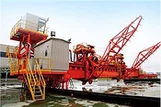
Hey there! As a supplier of Bucket Wheel Stackers, I'm super stoked to dive into the nitty - gritty of the braking system of these awesome machines.
Let's start with the basics. A Bucket Wheel Stacker is a beast in the material handling world. It's used in ports, mines, and power plants to stack and reclaim bulk materials like coal, ore, and grains. And just like any heavy - duty machinery, a reliable braking system is crucial for its safe and efficient operation.
Types of Braking Systems in Bucket Wheel Stackers
There are mainly two types of braking systems commonly used in Bucket Wheel Stackers: mechanical brakes and hydraulic brakes.
Mechanical Brakes
Mechanical brakes are the old - school yet still very effective option. They work on the principle of friction. When the brake is engaged, a brake shoe or pad is pressed against a rotating surface, usually a brake drum or disc. This creates friction, which slows down and eventually stops the rotation of the wheel or the moving part of the stacker.
One of the biggest advantages of mechanical brakes is their simplicity. They're relatively easy to understand, install, and maintain. You don't need a complex hydraulic system or a lot of high - tech components. For small - scale Bucket Wheel Stackers or those in less demanding environments, mechanical brakes can be a cost - effective solution.
However, they do have their limitations. Over time, the brake shoes or pads wear out and need to be replaced. Also, in wet or dirty conditions, the braking performance can be affected as the friction coefficient between the brake shoe and the drum/disc may change.
Hydraulic Brakes
Hydraulic brakes, on the other hand, use hydraulic fluid to transmit force. When you apply the brake, a piston in the master cylinder pushes hydraulic fluid through a series of pipes to the brake calipers or cylinders at the wheels. The pressure of the fluid causes the brake pads to squeeze against the brake disc, creating the braking force.
Hydraulic brakes offer several benefits. They can generate a much higher braking force compared to mechanical brakes. This is especially important for large - scale Bucket Wheel Stackers that need to stop heavy loads quickly and safely. They also provide a more consistent braking performance, as the hydraulic system can compensate for minor variations in the braking surfaces.
But hydraulic brakes are more complex and expensive to install and maintain. You need to regularly check the hydraulic fluid level, and any leaks in the system can lead to a loss of braking performance. Also, if there's a problem with the hydraulic pump or the valves, it can be more difficult and time - consuming to diagnose and fix.
Components of the Braking System
Brake Discs or Drums
These are the rotating parts against which the brake pads or shoes press. Brake discs are commonly used in modern Bucket Wheel Stackers because they offer better heat dissipation. When the brakes are applied, a lot of heat is generated due to friction. If the heat isn't dissipated properly, it can cause the brake pads to overheat and lose their effectiveness. Brake drums, on the other hand, are more enclosed and can retain heat, which may lead to brake fade in some cases.
Brake Pads or Shoes
As mentioned earlier, these are the parts that come into contact with the brake discs or drums to create friction. They're usually made of materials that have a high friction coefficient and can withstand high temperatures. Different types of materials are used depending on the application and the requirements of the Bucket Wheel Stacker. For example, semi - metallic brake pads are commonly used for their good balance of performance and durability.
Brake Calipers or Cylinders
In hydraulic braking systems, the brake calipers are responsible for squeezing the brake pads against the brake disc. They contain pistons that are activated by the hydraulic pressure. In mechanical braking systems, brake cylinders or levers are used to apply the force to the brake shoes.


Master Cylinder (Hydraulic Brakes)
The master cylinder is the heart of the hydraulic braking system. It converts the mechanical force applied by the brake pedal or lever into hydraulic pressure. When you press the brake, the piston in the master cylinder moves, forcing the hydraulic fluid out into the system.
Importance of a Good Braking System
A well - functioning braking system is of utmost importance for a Bucket Wheel Stacker. Safety is the number one reason. In a busy industrial environment, the stacker may need to stop suddenly to avoid collisions with other equipment or personnel. A reliable braking system ensures that the stacker can come to a halt quickly and safely.
Efficiency is another key factor. A good braking system allows for precise control of the stacker's movement. This means that operators can position the stacker accurately for stacking and reclaiming operations, which in turn increases productivity.
Different Models and Their Braking Systems
We offer a range of Bucket Wheel Stackers, each with its own unique braking system requirements. For example, our Bridge Bucket Wheel Stacker Reclaimer is a large - scale machine used for handling huge amounts of bulk materials. It requires a high - performance braking system, usually a hydraulic one, to ensure safe and efficient operation.
Our Bucket Wheel Stacker Reclaimer is a versatile model that can be used in various applications. Depending on the customer's needs, we can configure it with either a mechanical or a hydraulic braking system.
The Cantilever Bucket Wheel Stacker is a more compact and agile option. For this model, a mechanical braking system may be sufficient in some cases, but for heavier loads or more demanding operations, a hydraulic system can be installed.
Maintenance of the Braking System
Regular maintenance is essential to keep the braking system of a Bucket Wheel Stacker in top condition. For mechanical brakes, you should check the brake shoes regularly for wear and replace them when necessary. You also need to lubricate the moving parts to ensure smooth operation.
For hydraulic brakes, in addition to checking the brake pads, you need to monitor the hydraulic fluid level and look for any signs of leaks. The hydraulic fluid should be changed at regular intervals according to the manufacturer's recommendations.
Conclusion
In conclusion, the braking system of a Bucket Wheel Stacker is a critical component that ensures safety and efficiency. Whether you choose a mechanical or a hydraulic braking system depends on various factors such as the size of the stacker, the type of materials it handles, and the operating environment.
If you're in the market for a Bucket Wheel Stacker or need to upgrade the braking system of your existing one, we're here to help. Our team of experts can provide you with the best advice and solutions tailored to your specific needs. Don't hesitate to get in touch with us for more information and to start a procurement discussion.
References
- General knowledge of heavy - duty machinery braking systems
- Manufacturer's manuals for Bucket Wheel Stackers