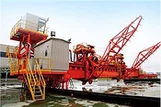
Hey there! As a supplier of Mobile Ship Loaders, I often get asked about the differences between Mobile Ship Loaders and Fixed Ship Loaders. So, I thought I'd take a few minutes to break it down for you.
What's a Fixed Ship Loader?
Let's start with the Fixed Ship Loader. As the name suggests, these loaders are, well, fixed in one place. They're usually installed at a specific berth in a port or terminal. Fixed Ship Loaders are built to handle large - scale bulk material loading operations. They're designed to work with a consistent type of vessel that comes to the same berth regularly.
The Fixed Bulk Ship Loader is a heavy - duty piece of equipment. It's often made up of a large boom structure that can reach out over the ship's hold. The boom is usually equipped with a conveyor system that transports the bulk material, like coal, grain, or ore, from the storage area on land to the ship.
One of the big advantages of a Fixed Ship Loader is its high loading capacity. Since it's a permanent installation, it can be customized and optimized for a particular type of cargo and ship size. This means it can load large quantities of material quickly and efficiently. For example, in a coal - exporting port, a Fixed Ship Loader can load thousands of tons of coal into a bulk carrier in a relatively short time.
However, fixed loaders also have their limitations. They're not very flexible. Once installed, it's difficult and expensive to move them to another location. If there are changes in the shipping routes, vessel sizes, or types of cargo, a fixed loader may not be able to adapt easily. Also, if there's maintenance or repair work needed on the fixed loader, it can disrupt the entire loading operation at that berth.
What's a Mobile Ship Loader?
Now, let's talk about Mobile Ship Loaders. These are the products I'm really passionate about as a supplier. A Mobile Bulk Ship Loader is a self - propelled or wheeled unit that can move around the port area. It offers a high level of flexibility that fixed loaders just can't match.
Mobile Ship Loaders come in different sizes and configurations. Some are small enough to be used in smaller ports or for loading barges, while others are large and powerful enough to handle big bulk carriers. They're equipped with a conveyor system, just like fixed loaders, but they also have the ability to move along the quay, adjust their height, and position themselves for different ship sizes and loading requirements.
One of the main benefits of a Mobile Ship Loader is its mobility. It can be easily moved from one berth to another, which is great if you have multiple ships arriving at different locations in the port. This means you can use a single loader to serve several berths, reducing the need for multiple fixed loaders. For example, if a small vessel arrives at one berth and a large one at another, the mobile loader can quickly move between them to handle the loading.
Another advantage is its quick setup and teardown. If there's a short - term loading project or a sudden increase in demand, a mobile loader can be deployed rapidly. It doesn't require a long - term installation process like a fixed loader. This makes it a great option for ports that have variable cargo volumes or need to respond quickly to market changes.
Mobile Ship Loaders are also more suitable for handling different types of cargo. They can be fitted with different types of discharge heads or conveyor attachments to handle various bulk materials, from fine powders to large rocks. And if you're dealing with Barge Loader Equipment, a mobile loader can be easily adjusted to the lower height and smaller size of a barge.
But mobile loaders aren't without their drawbacks. Generally, their loading capacity is lower compared to fixed loaders. Since they're designed to be mobile, they may not be as heavy - duty as fixed loaders, which can limit the amount of material they can load per hour. Also, they may require more maintenance due to their moving parts.
Key Differences in a Nutshell
- Flexibility: Mobile Ship Loaders win hands - down in this category. They can move around the port, adapt to different berths, and handle various ship sizes and cargo types. Fixed Ship Loaders are stuck in one place and are less adaptable to changes.
- Loading Capacity: Fixed Ship Loaders usually have a higher loading capacity. They're built for large - scale, high - volume loading operations. Mobile Ship Loaders, while still capable of significant loading, may not be able to match the sheer quantity that fixed loaders can handle.
- Installation and Setup: Fixed Ship Loaders require a long - term installation process and a dedicated berth. Mobile Ship Loaders can be quickly set up and moved as needed, making them ideal for short - term or variable - volume projects.
- Cost: The initial cost of a Fixed Ship Loader is often higher due to the construction and installation requirements. Mobile Ship Loaders may have a lower upfront cost, but they may incur higher maintenance costs over time because of their moving parts.
Which One Should You Choose?
The choice between a Mobile Ship Loader and a Fixed Ship Loader depends on several factors. If you have a large, established port with a consistent flow of the same type of cargo and ships, a Fixed Ship Loader might be the best option. It can provide high - speed, high - volume loading and long - term reliability.
On the other hand, if your port has variable cargo volumes, different ship sizes, or short - term loading projects, a Mobile Ship Loader is likely to be a better fit. It offers the flexibility and quick response time that can help you adapt to changing market conditions.


As a supplier of Mobile Ship Loaders, I believe that these machines offer a lot of value to ports and terminals. They can help you optimize your loading operations, reduce costs, and increase efficiency. If you're in the market for a ship loader and are considering a Mobile Ship Loader, I'd love to have a chat with you. We can discuss your specific needs, cargo types, and port requirements to find the best solution for you. Whether you're dealing with large bulk carriers or smaller barges, our Mobile Ship Loaders can be customized to meet your exact needs.
So, if you're interested in learning more about our Mobile Ship Loaders or want to discuss a potential purchase, don't hesitate to reach out. We're here to help you make the right decision for your business.
References
- Industry reports on ship loading equipment
- Technical specifications of Mobile and Fixed Ship Loaders from leading manufacturers
- Case studies of ports using Mobile and Fixed Ship Loaders