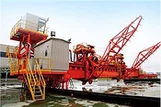
In the world of bulk material handling, circular stackers play a pivotal role in efficiently storing and reclaiming large quantities of materials such as coal, ore, and grains. As a leading supplier of circular stackers, I often receive inquiries about the maximum stacking radius of these machines. In this blog post, I will delve into the factors that determine the maximum stacking radius of a circular stacker and provide insights into how our products are designed to optimize this crucial parameter.
Understanding the Basics of Circular Stackers
Before we discuss the maximum stacking radius, let's first understand the basic operation of a circular stacker. A circular stacker is a type of material handling equipment that is used to stack bulk materials in a circular pattern. It consists of a central column, a boom conveyor, and a slew mechanism that allows the boom to rotate around the central column. The material is fed onto the boom conveyor at the center of the stacker and is then discharged at the end of the boom to form a circular pile.
The stacking radius of a circular stacker refers to the maximum distance from the center of the stacker to the outer edge of the material pile. This parameter is crucial as it determines the capacity and efficiency of the stacker. A larger stacking radius allows for the creation of larger material piles, which in turn increases the storage capacity of the facility. Additionally, a larger stacking radius can also improve the efficiency of the stacking process by reducing the number of cycles required to fill a given area.
Factors Affecting the Maximum Stacking Radius
Several factors influence the maximum stacking radius of a circular stacker. These factors can be broadly categorized into mechanical, structural, and operational considerations.
Mechanical Factors
The mechanical design of the circular stacker plays a significant role in determining its maximum stacking radius. The length and strength of the boom conveyor are critical factors. A longer boom allows for a greater stacking radius, but it also requires a more robust structure to support its weight and the weight of the material being conveyed. The slew mechanism, which is responsible for rotating the boom around the central column, also needs to be designed to handle the increased torque and load associated with a larger stacking radius.
Another mechanical factor is the conveyor belt speed. A higher belt speed can increase the rate at which material is discharged from the boom, allowing for the creation of larger piles in a shorter period. However, increasing the belt speed also requires careful consideration of the conveyor's power requirements and the potential for material spillage.
Structural Factors
The structural integrity of the circular stacker is essential for ensuring a safe and reliable operation at the maximum stacking radius. The central column, which supports the entire structure of the stacker, needs to be designed to withstand the lateral forces and moments generated by the rotating boom and the material pile. The foundation of the stacker also plays a crucial role in providing a stable base for the machine. A well-designed foundation can distribute the loads evenly and prevent excessive settlement or tilting of the stacker.
The boom structure itself needs to be engineered to resist bending and torsional stresses. As the stacking radius increases, the boom experiences greater bending moments, which can lead to structural failure if not properly addressed. Advanced materials and design techniques, such as the use of high-strength steel and optimized cross-sectional shapes, can help to enhance the structural performance of the boom.
Operational Factors
Operational factors also have a significant impact on the maximum stacking radius of a circular stacker. The type and properties of the material being stacked can affect the stability of the material pile. For example, materials with a high angle of repose, such as coal or ore, can form steeper piles, allowing for a larger stacking radius. On the other hand, materials with a low angle of repose, such as grains or powders, may require a smaller stacking radius to prevent the pile from collapsing.
The stacking pattern and method also influence the maximum stacking radius. Different stacking patterns, such as chevron, windrow, or cone-shell stacking, can affect the shape and stability of the material pile. The stacking method, whether it is continuous or batch stacking, can also impact the efficiency and capacity of the stacker.
Our Approach to Optimizing the Maximum Stacking Radius
As a circular stacker supplier, we understand the importance of optimizing the maximum stacking radius to meet the specific needs of our customers. Our engineering team uses advanced design tools and simulation techniques to analyze the mechanical, structural, and operational factors that affect the stacking radius.


We start by working closely with our customers to understand their requirements, including the type and quantity of material to be stacked, the available space, and the desired stacking capacity. Based on this information, we design a customized circular stacker that is tailored to their specific needs.
In terms of mechanical design, we use high-quality components and advanced conveyor technology to ensure the reliability and efficiency of the stacker. Our boom conveyors are designed to be lightweight yet strong, using advanced materials and engineering techniques to maximize their length without compromising their structural integrity. The slew mechanism is carefully engineered to provide smooth and precise rotation, even at large stacking radii.
Structurally, we use state-of-the-art finite element analysis (FEA) software to analyze the stress and deformation of the stacker components under different loading conditions. This allows us to optimize the design of the central column, boom, and other structural elements to ensure that they can safely support the loads associated with a large stacking radius. We also pay close attention to the foundation design, working with geotechnical engineers to ensure that the foundation provides a stable base for the stacker.
Operationally, we provide our customers with comprehensive training and support to ensure that they can operate the stacker efficiently and safely. We also offer a range of automation and control systems that can optimize the stacking process, including the stacking pattern and belt speed, to maximize the stacking radius and capacity.
Related Products and Their Benefits
In addition to our circular stackers, we also offer a range of related products that can enhance the efficiency and functionality of your bulk material handling system. For example, our Cantilever Chain Reclaimer is a highly efficient machine for reclaiming materials from large piles. It is designed to work in conjunction with our circular stackers, allowing for seamless integration of the stacking and reclaiming processes.
Our Circular Overpile Stacker Reclaimer combines the functions of a stacker and a reclaimer in a single machine. This innovative design allows for the simultaneous stacking and reclaiming of materials, reducing the need for additional equipment and increasing the overall efficiency of the facility.
We also offer Stationary Stacking Conveyors that can be used to transport materials to and from the circular stacker. These conveyors are designed to be reliable and efficient, with a range of options available to suit different applications and requirements.
Conclusion and Call to Action
In conclusion, the maximum stacking radius of a circular stacker is a crucial parameter that determines its capacity and efficiency. By carefully considering the mechanical, structural, and operational factors that affect this parameter, we can design and manufacture circular stackers that offer optimal performance and reliability.
If you are in the market for a circular stacker or any other bulk material handling equipment, we invite you to contact us to discuss your specific requirements. Our team of experts will be happy to provide you with detailed information about our products and services and help you find the best solution for your needs. Whether you are looking to increase your storage capacity, improve your operational efficiency, or enhance the safety of your facility, we have the expertise and experience to deliver a customized solution that meets your expectations.
References
- Bulk Material Handling Handbook, Second Edition, by George Klinzing, et al.
- Conveyor Equipment Manufacturers Association (CEMA) Standards for Belt Conveyors
- American Society of Mechanical Engineers (ASME) Standards for Material Handling Equipment