Hey there, folks! As a supplier of Continuous Ship Unloaders (CSUs), I get asked a ton of questions about how these bad boys work. One of the most common questions I hear is, “What is the speed of the Continuous Ship Unloader's boom movement?” Well, let’s dive into this topic and find out!
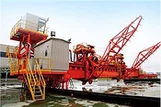
First off, it’s important to understand what the boom of a Continuous Ship Unloader is. The boom is like the long arm of the unloader. It’s the part that reaches out over the ship to pick up the cargo and move it to the conveyor system for transport. Think of it as a really big, really strong mechanical arm that does all the heavy - lifting (literally).
Now, the speed of the boom movement can vary quite a bit depending on several factors. First, the type of unloader matters. We have different kinds of Continuous Ship Unloaders, like the Screw Type Ship Unloader, Boom Jib, and Catenary Bucket Unloader. Each of these has its own unique design and functionality, which affects the boom movement speed.
Let's start with the Screw Type Ship Unloader. This type uses a large screw mechanism to dig into the cargo and move it. The boom on a Screw Type Ship Unloader usually moves at a relatively steady speed. It needs to be slow enough to ensure that the screw can properly penetrate the cargo and pick it up efficiently. On average, the horizontal movement speed of the boom might be around 5 - 10 meters per minute. The vertical movement, like raising or lowering the boom, can be a bit faster, sometimes reaching up to 15 meters per minute. This allows the unloader to quickly adjust the height to reach different levels of cargo in the ship's hold.
The Boom Jib is another popular type. It's designed to have a lot of flexibility in its movement. The boom on a Boom Jib can move in multiple directions - horizontally, vertically, and even pivot. This flexibility is great for reaching different parts of the ship. The speed of the horizontal movement of the boom jib can be quite fast. In some cases, it can move up to 20 meters per minute, which is pretty impressive. This high speed is useful when you need to cover a large area of the ship quickly. For vertical movement, it might be a bit slower, around 10 - 15 meters per minute, as precision is often needed when lifting the cargo to the right height.
Now, let's talk about the Catenary Bucket Unloader. This type uses a series of buckets attached to a chain to scoop up the cargo. The boom movement of a Catenary Bucket Unloader is affected by the way the buckets are operating. The horizontal movement speed is usually in the range of 8 - 12 meters per minute. This speed allows the buckets to move along the ship's hold at a pace that ensures continuous and efficient unloading. The vertical movement speed can be adjusted according to the depth of the cargo in the hold, but it typically ranges from 8 - 10 meters per minute.
Another factor that affects the boom movement speed is the type of cargo. If the cargo is light and easy to handle, like grains, the boom can move a bit faster. The unloader doesn't have to work as hard to pick up and transfer the cargo. On the other hand, if the cargo is heavy and dense, such as coal or iron ore, the boom has to move more slowly. This is because more force is required to lift and move the heavy cargo, and moving too fast could cause problems like spillage or damage to the equipment.
The size of the ship and the layout of the port also play a role. In a large port with big ships, the unloader needs to cover a larger area. So, it might have a faster boom movement speed to make the unloading process more efficient. But in a smaller port with limited space, the boom might need to move more carefully and at a slower speed to avoid hitting other structures or vessels.
Maintenance and the age of the equipment are also important. A well - maintained Continuous Ship Unloader is going to have a more consistent and reliable boom movement speed. On the other hand, an older or poorly maintained unloader might experience problems that slow down the boom movement. For example, if the gears or motors that control the boom movement are worn out, it can cause the speed to decrease or become inconsistent.
So, to sum it up, there isn't a one - size - fits - all answer to the question of what the speed of the Continuous Ship Unloader's boom movement is. It depends on the type of unloader, the type of cargo, the size of the ship, the port layout, and the condition of the equipment.
If you're in the market for a Continuous Ship Unloader, it's crucial to consider all these factors. You want an unloader that can move its boom at a speed that suits your specific needs. Whether you're dealing with light or heavy cargo, working in a large or small port, we have the right solution for you.
We've got a team of experts who can help you choose the best Continuous Ship Unloader for your operation. They can analyze your requirements and recommend the type of unloader and the appropriate boom movement speed for maximum efficiency and productivity.


If you're interested in learning more or want to start a conversation about purchasing a Continuous Ship Unloader, don't hesitate to reach out. We're here to answer all your questions and guide you through the process. Let's work together to find the perfect unloader for your business!
References:
- Industry reports on Continuous Ship Unloaders
- Technical specifications of different types of Continuous Ship Unloaders