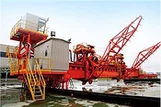
As a supplier of Discontinuous Ship Unloaders, I often get asked about the unloading capacity of a typical discontinuous ship unloader. It's a valid question, especially for those who are in the business of shipping and port operations. Knowing the unloading capacity can help in planning the logistics, estimating the time required for unloading, and making decisions about the type of unloader to invest in.
Let's first understand what a discontinuous ship unloader is. Unlike continuous ship unloaders that operate in a smooth, uninterrupted manner, discontinuous ship unloaders work in a series of cycles. They pick up a certain amount of cargo, move it to a designated area, unload it, and then go back for more. This stop - and - go operation affects the unloading capacity in different ways compared to continuous unloaders.
There are several types of discontinuous ship unloaders, each with its own unique unloading capacity characteristics. The most common ones include the Grab Type Ship Unloader, Query - side Container Crane, and Grab Bucket Gantry Crane.
Grab Type Ship Unloader
The grab type ship unloader is one of the most widely used discontinuous unloaders in the industry. It uses a grab bucket to scoop up the cargo, which can range from bulk materials like coal, grains, to ores. The unloading capacity of a grab type ship unloader depends on a few key factors.
Firstly, the size of the grab bucket matters a lot. A larger grab bucket can hold more cargo per cycle. For example, a small - scale grab type unloader might have a grab bucket with a capacity of around 1 - 2 cubic meters. This type of unloader is often used in smaller ports or for handling less - voluminous cargo. On the other hand, a large - scale grab type unloader can have a grab bucket capacity of 10 - 20 cubic meters or even more. These are used in major ports for handling large quantities of bulk cargo.
Another factor is the cycle time. The cycle time includes the time it takes for the grab to descend into the hold of the ship, close around the cargo, lift the cargo out of the hold, move it to the discharge point, open the grab to release the cargo, and then return to the hold for the next cycle. A well - designed grab type ship unloader can have a relatively short cycle time. For instance, in some efficient models, the cycle time can be as short as 60 - 90 seconds.
Let's do a quick calculation to understand the unloading capacity better. Suppose we have a grab type ship unloader with a grab bucket capacity of 15 cubic meters and a cycle time of 90 seconds. In one hour (3600 seconds), the number of cycles it can complete is 3600 / 90 = 40 cycles. So, the hourly unloading capacity would be 15 * 40 = 600 cubic meters. However, this is a theoretical value. In real - world scenarios, factors like the type of cargo (its density, flowability), the condition of the ship's hold, and operator skills can affect the actual unloading capacity.
Query - side Container Crane
The query - side container crane is mainly used for unloading containers from ships. The unloading capacity of a query - side container crane is measured in terms of the number of containers it can unload per hour.
The key determinant of its capacity is the lifting speed and the time taken for container handling. Modern query - side container cranes are designed to be very efficient. They can have a lifting speed of up to 100 - 120 meters per minute. The time taken for operations like picking up the container from the ship, moving it to the quay, and releasing it onto a truck or a storage area is also optimized.
A typical query - side container crane can unload around 20 - 40 twenty - foot equivalent units (TEUs) per hour. However, this can vary depending on the complexity of the container stowage on the ship. If the containers are stacked in a disorganized way or if there are special handling requirements, the unloading capacity can be reduced.
Grab Bucket Gantry Crane
The grab bucket gantry crane is similar to the grab type ship unloader in some ways, but it has a gantry structure that allows it to move along the quay. This gives it more flexibility in terms of accessing different parts of the ship.
The unloading capacity of a grab bucket gantry crane is also influenced by the grab bucket size and the cycle time. Similar to the grab type ship unloader, larger grab buckets and shorter cycle times result in higher unloading capacities. A medium - sized grab bucket gantry crane with a grab bucket capacity of 8 cubic meters and a cycle time of 120 seconds can unload around 240 cubic meters per hour.
In real - world port operations, the actual unloading capacity is often lower than the theoretical values. There are many factors that can cause this reduction. Weather conditions play a big role. High winds can make it difficult to operate the grab or the crane safely, leading to longer cycle times. The type of cargo also affects the capacity. For example, sticky or cohesive cargo can cause problems when the grab tries to release the cargo, increasing the cycle time.


Maintenance and downtime are other important considerations. Regular maintenance is essential to keep the discontinuous ship unloaders in good working condition. However, during maintenance periods, the unloading capacity drops to zero. And if there are any breakdowns, it can take hours or even days to get the equipment up and running again.
When choosing a discontinuous ship unloader, it's crucial to consider the expected unloading capacity based on your specific requirements. If you're dealing with large - volume bulk cargo, a grab type ship unloader or a grab bucket gantry crane with a large grab bucket capacity might be the best choice. For container - based cargo, a query - side container crane is the obvious option.
If you're in the market for a discontinuous ship unloader and want to learn more about the unloading capacity and which type is best for your needs, don't hesitate to reach out. We're here to help you make the right decision and ensure that your port operations run smoothly and efficiently. Whether you have a small - scale port or a large - scale international shipping hub, we have the expertise and the right equipment to meet your requirements. Contact us today to start the conversation about your shipping and unloading needs.
References
- Shipping Industry Handbook on Port Equipment
- Journal of Port and Maritime Engineering