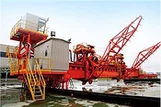
As a supplier of discontinuous ship unloaders, I've witnessed firsthand the remarkable versatility and efficiency of these machines in handling a wide range of ship sizes. In this blog post, I'll delve into the intricacies of how discontinuous ship unloaders operate with different ship sizes, exploring the key mechanisms, challenges, and solutions involved.
Understanding Discontinuous Ship Unloaders
Discontinuous ship unloaders are designed to transfer bulk materials, such as coal, ore, grain, and fertilizers, from ships to on - shore storage facilities. Unlike continuous ship unloaders that operate in a continuous flow, discontinuous ship unloaders work in a step - by - step manner. They typically use grabs or buckets to scoop up the cargo from the ship's hold and then transport it to the discharge point.
There are several types of discontinuous ship unloaders, including Grab Type Ship Unloader and Grab Bucket Gantry Crane. Each type has its own unique features and advantages, but they all share the common goal of efficiently unloading cargo from ships.
Working with Small - Sized Ships
Small - sized ships, such as coastal vessels or barges, present a different set of challenges and opportunities for discontinuous ship unloaders. These ships usually have limited hold space and lower cargo volumes compared to larger vessels.
One of the key advantages of using discontinuous ship unloaders for small - sized ships is their flexibility. The grab or bucket can be easily adjusted to fit the size and shape of the ship's hold. This allows for precise cargo handling, minimizing spillage and ensuring efficient unloading.
For example, a Grab Type Ship Unloader can be equipped with a smaller grab to match the dimensions of a small - sized ship's hold. The operator can then use the grab to scoop up the cargo in small increments, carefully navigating around any obstacles in the hold.
Another benefit is the relatively low cost of operation. Since small - sized ships carry less cargo, the unloading process is generally quicker and requires less energy. This can result in significant cost savings for both the shipowner and the terminal operator.
However, working with small - sized ships also has its challenges. The limited hold space can make it difficult to maneuver the grab or bucket, especially in ships with complex hold geometries. Additionally, the smaller cargo volumes may not fully utilize the capacity of the ship unloader, leading to lower overall efficiency.
Handling Medium - Sized Ships
Medium - sized ships are a common sight in many ports around the world. These ships typically have larger hold capacities than small - sized vessels but are still more manageable than large - scale bulk carriers.
Discontinuous ship unloaders are well - suited for medium - sized ships due to their ability to handle a wide range of cargo volumes. The grab or bucket can be adjusted to accommodate different cargo densities and quantities, ensuring efficient unloading.
One of the key considerations when working with medium - sized ships is the balance between speed and precision. The ship unloader needs to operate at a sufficient speed to meet the port's throughput requirements, but also with enough precision to avoid damage to the ship and the cargo.
For instance, a Grab Bucket Gantry Crane can be used to unload medium - sized ships. The gantry crane provides a stable platform for the grab, allowing for smooth and accurate movement. The operator can control the crane's movement and the opening and closing of the grab to optimize the unloading process.
Another aspect to consider is the cargo type. Medium - sized ships may carry a variety of bulk materials, each with its own unique handling requirements. For example, unloading grain requires different techniques compared to unloading coal. The ship unloader needs to be equipped with the appropriate grab or bucket and have the necessary controls to handle different cargo types effectively.
Dealing with Large - Sized Ships
Large - sized ships, such as Panamax or Capesize bulk carriers, pose the most significant challenges for discontinuous ship unloaders. These ships have massive hold capacities and can carry thousands of tons of cargo.
One of the main challenges is the sheer volume of cargo that needs to be unloaded. Discontinuous ship unloaders need to be able to handle large - scale operations efficiently. This often requires multiple grabs or buckets working in tandem to increase the unloading rate.
For example, a Query - side Container Crane can be used in combination with other discontinuous ship unloaders to unload large - sized ships. The crane can be used to handle the initial stages of unloading, such as removing the top layer of cargo, while the other unloaders work on the remaining cargo in the hold.
Another challenge is the depth of the ship's hold. Large - sized ships often have deep holds, which can make it difficult for the grab or bucket to reach the bottom of the hold. To overcome this, some discontinuous ship unloaders are equipped with extendable booms or telescopic grabs that can reach deeper into the hold.
In addition, the stability of the ship unloader is crucial when working with large - sized ships. The heavy loads and strong winds associated with these ships can put significant stress on the unloader. Therefore, the unloader needs to be properly designed and installed to ensure its stability during operation.
Technological Advancements
In recent years, there have been significant technological advancements in the field of discontinuous ship unloaders. These advancements have improved the efficiency, safety, and reliability of the unloading process, especially when dealing with different ship sizes.
One of the key technological advancements is the use of automation and remote control systems. These systems allow the operator to control the ship unloader from a safe distance, reducing the risk of accidents and improving the overall efficiency of the unloading process. For example, the operator can use a computer - based control system to program the movement of the grab or bucket, ensuring precise and consistent cargo handling.
Another advancement is the development of more advanced grabs and buckets. These new designs are more efficient at scooping up and holding the cargo, reducing spillage and improving the overall unloading rate. For instance, some grabs are now equipped with sensors that can detect the amount of cargo in the grab and adjust the opening and closing of the grab accordingly.
Conclusion
Discontinuous ship unloaders are a vital part of the global shipping and logistics industry. Their ability to work with different ship sizes makes them a versatile and valuable asset for ports and terminals around the world.


Whether it's a small - sized coastal vessel, a medium - sized bulk carrier, or a large - scale Panamax ship, discontinuous ship unloaders can be customized and optimized to meet the specific requirements of each ship. With the continuous advancements in technology, the efficiency and performance of these unloaders are only going to improve in the future.
If you're in the market for a discontinuous ship unloader or have any questions about how these machines can work with different ship sizes, I encourage you to reach out to us. We have a team of experts who can provide you with detailed information and help you find the best solution for your needs.
References
- "Bulk Material Handling Handbook", Second Edition, by J. Y. Yang
- "Maritime Cargo Handling Technology", edited by S. N. Samanta
- Industry reports on ship unloading technologies and trends from leading research firms.