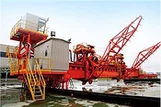
As a provider of Mobile Bulk Ship Loaders, I've witnessed firsthand the intricate dance of synchronizing these powerful machines with a ship's loading plan. This synchronization is not just a technical feat; it's a critical process that ensures efficiency, safety, and accuracy in the bulk shipping industry. In this blog, I'll delve into the key aspects of how a Mobile Bulk Ship Loader synchronizes with the ship's loading plan, exploring the technologies, processes, and challenges involved.
Understanding the Ship's Loading Plan
Before any loading operation can begin, a detailed loading plan is developed. This plan takes into account various factors such as the ship's cargo capacity, stability requirements, and the type of cargo to be loaded. The goal is to distribute the cargo evenly across the ship to maintain its stability during transit. The loading plan also specifies the sequence in which different cargoes should be loaded, as well as the locations within the ship's holds where each cargo should be placed.
As a Mobile Bulk Ship Loader supplier, we work closely with shipping companies and port operators to understand their specific loading plans. Our team of experts analyzes the plan to determine the optimal configuration and operation of the loader. This includes factors such as the loader's reach, capacity, and the speed at which it can transfer cargo.
Technologies for Synchronization
One of the key technologies used in synchronizing a Mobile Bulk Ship Loader with the ship's loading plan is automation. Modern loaders are equipped with advanced control systems that can be programmed to follow a specific loading sequence. These systems use sensors and actuators to monitor and adjust the loader's position, speed, and the flow of cargo.
For example, laser sensors can be used to measure the distance between the loader and the ship's hold, ensuring that the loader is positioned accurately. Proximity sensors can detect the presence of cargo in the hold, allowing the loader to adjust its operation accordingly. Actuators, such as hydraulic cylinders, can be used to control the movement of the loader's boom and conveyor belts.
Another important technology is communication systems. Loaders are often connected to a central control room, where operators can monitor the loading process in real-time. This allows them to make adjustments to the loader's operation as needed, based on changes in the ship's loading plan or unexpected conditions.
Wireless communication technologies, such as Wi-Fi and Bluetooth, are also used to enable communication between the loader and other equipment on the ship. This includes devices such as cranes, forklifts, and conveyor systems. By integrating these systems, the loading process can be streamlined and made more efficient.
The Synchronization Process
The synchronization process begins with the setup of the Mobile Bulk Ship Loader. The loader is positioned at the appropriate location alongside the ship, and its boom is extended to reach the ship's hold. The conveyor belts are then started, and the cargo is fed into the loader.
Once the loader is operational, it follows the loading plan programmed into its control system. The loader's sensors continuously monitor the position of the ship's hold and the flow of cargo, making adjustments as needed to ensure that the cargo is loaded evenly and accurately.
During the loading process, the operator in the control room monitors the progress of the loader and the ship's stability. If any issues arise, such as a change in the ship's trim or a blockage in the conveyor system, the operator can take immediate action to address the problem.
Once the loading of a particular hold is complete, the loader moves to the next hold and repeats the process. This continues until all the cargo has been loaded onto the ship.
Challenges in Synchronization
Despite the advanced technologies and processes used in synchronizing a Mobile Bulk Ship Loader with the ship's loading plan, there are still several challenges that need to be overcome.


One of the main challenges is the variability of the ship's loading conditions. Ships come in different sizes and shapes, and their holds may have different configurations. This means that the loader needs to be flexible enough to adapt to these variations.
Another challenge is the weather conditions. Strong winds, heavy rain, and rough seas can all affect the stability of the ship and the operation of the loader. In such conditions, the loading process may need to be slowed down or even stopped to ensure safety.
Finally, there is the challenge of coordinating the activities of multiple pieces of equipment. In a busy port, there may be several loaders, cranes, and other equipment operating simultaneously. Ensuring that these equipment work together smoothly and efficiently requires effective communication and coordination.
Our Solutions as a Supplier
As a Mobile Bulk Ship Loader supplier, we understand the challenges involved in synchronizing our loaders with the ship's loading plan. That's why we offer a range of solutions to help our customers overcome these challenges.
Our loaders are designed to be highly flexible and adaptable. They can be customized to meet the specific requirements of different ships and loading plans. For example, our Mobile Bulk Ship Loader can be equipped with different types of booms and conveyor belts to suit different cargoes and ship configurations.
We also offer advanced control systems that can be programmed to optimize the loader's operation. These systems use artificial intelligence and machine learning algorithms to analyze the loading data and make adjustments in real-time. This helps to improve the efficiency and accuracy of the loading process.
In addition, we provide training and support to our customers to ensure that they can operate our loaders safely and effectively. Our team of experts is available 24/7 to provide technical assistance and advice.
Conclusion
Synchronizing a Mobile Bulk Ship Loader with the ship's loading plan is a complex but essential process in the bulk shipping industry. By using advanced technologies, effective communication, and careful planning, this process can be made more efficient, safe, and accurate.
As a Mobile Bulk Ship Loader supplier, we are committed to providing our customers with the best possible solutions for their loading needs. Our loaders are designed to meet the highest standards of quality and performance, and our team of experts is dedicated to ensuring that our customers have a successful loading experience.
If you are interested in learning more about our Mobile Bulk Ship Loaders or discussing your specific loading requirements, please contact us. We would be happy to provide you with more information and answer any questions you may have.
References
- International Maritime Organization (IMO). "Safety of Bulk Carriers." IMO Publications, 2020.
- Port Technology International. "Advances in Bulk Ship Loading Technology." Port Technology International, 2021.
- Ship & Bunker. "Optimizing Bulk Ship Loading Operations." Ship & Bunker, 2022.