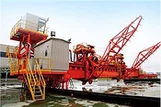
Hey there! As a supplier of Screw Type Ship Unloaders, I often get asked about how these nifty machines interact with a port's storage facilities. It's a super interesting topic, and I'm stoked to share some insights with you.
First off, let's talk a bit about what a Screw Type Ship Unloader is. It's a piece of equipment designed to efficiently unload bulk materials, like grains, coal, or minerals, from ships. The basic principle is pretty simple: a large screw conveyor rotates and moves the materials from the ship's hold to a discharge point. This process is continuous and can handle a significant amount of cargo in a relatively short time.
Now, when it comes to interacting with the port's storage facilities, there are a few key steps and processes involved.
The Initial Connection
Once the ship arrives at the port and is properly docked, the Screw Type Ship Unloader needs to be positioned correctly. This is usually done with the help of a mobile platform that can move along the pier. The operator will align the unloader's intake hopper with the ship's hold. This is crucial because any misalignment can lead to inefficiencies or even damage to the equipment.
As soon as the unloader is in position, the screw conveyor starts to rotate, and the bulk materials are gradually scooped up from the hold. The materials are then transported along the conveyor towards the discharge end.
Transfer to Intermediate Conveyors
Most of the time, the Screw Type Ship Unloader doesn't directly deposit the materials into the storage facilities. Instead, it transfers the materials to intermediate conveyors. These conveyors act as a bridge between the unloader and the storage area.


The advantage of using intermediate conveyors is that they can be more easily adjusted and configured to suit the layout of the port. They can also handle different types of materials more efficiently. For example, if the port stores different kinds of grains separately, the intermediate conveyors can be directed to different storage areas accordingly.
During this transfer process, it's important to ensure that the flow of materials is smooth and continuous. Any blockages or interruptions can cause delays and increase the overall unloading time. That's why regular maintenance and monitoring of both the unloader and the intermediate conveyors are essential.
Storage Facility Entry
Once the materials reach the end of the intermediate conveyors, they are ready to enter the storage facilities. There are different types of storage facilities in ports, such as silos, warehouses, or open storage yards.
If the materials are going into a silo, they are usually transferred using gravity or additional conveyor systems. Silos are great for storing bulk materials in a compact and organized way. They can also protect the materials from the elements, which is especially important for sensitive materials like grains.
For warehouses, the materials might be loaded onto trucks or other handling equipment for further storage or distribution within the warehouse. In open storage yards, the materials can be directly deposited onto the ground or stacked in piles.
Compatibility and Customization
One of the great things about Screw Type Ship Unloaders is their flexibility. They can be customized to work with different types of port storage facilities. For example, if the port has a unique layout or specific requirements, the unloader can be designed with adjustable discharge heights, angles, or conveyor lengths.
This compatibility is crucial because every port is different. Some ports might have limited space, while others might need to handle a high volume of cargo quickly. By working closely with the port operators, we can ensure that the Screw Type Ship Unloader is tailored to meet their specific needs.
Comparison with Other Ship Unloaders
It's worth mentioning that there are other types of ship unloaders available in the market, like the Buried Scraper Type Ship Unloader and the Chain Bucket Ship Unloader. Each type has its own advantages and disadvantages.
The Buried Scraper Type Ship Unloader uses a scraper chain to move the materials. It's suitable for materials that are difficult to handle with a screw conveyor, such as sticky or abrasive materials. However, it might require more complex maintenance and have a higher initial cost.
The Chain Bucket Ship Unloader, on the other hand, uses a series of buckets attached to a chain to scoop up the materials. It's often used for handling heavy and large - sized materials. But it might not be as efficient as a Screw Type Ship Unloader for fine - grained materials.
In comparison, our Screw Type Ship Unloaders offer a good balance of efficiency, versatility, and cost - effectiveness. They are relatively easy to operate and maintain, and can be quickly adjusted to handle different types of bulk materials.
Our Fixed Screw Ship Unloader
We also offer the Fixed Screw Ship Unloader. This type of unloader is ideal for ports that have a consistent type of cargo and a fixed layout. It's a more cost - efficient option as it doesn't require the complex mobility features of some other models.
The fixed screw design ensures a stable and reliable unloading process. It can handle a large volume of materials without much interruption, making it a popular choice for many ports.
Importance of Communication and Integration
To ensure a smooth interaction between the Screw Type Ship Unloader and the port's storage facilities, communication and integration are key. The port operators need to have a clear understanding of the unloader's capabilities and limitations. At the same time, the unloader's operators should be familiar with the storage facilities' layout and requirements.
This can be achieved through proper training and documentation. We always provide detailed operation manuals and on - site training for the port staff. This helps to minimize errors and improve the overall efficiency of the unloading process.
Conclusion
In conclusion, the interaction between a Screw Type Ship Unloader and a port's storage facilities is a complex but well - organized process. From the initial positioning of the unloader to the final storage of the materials, every step requires careful planning and execution.
If you're in the market for a ship unloader and are considering a Screw Type Ship Unloader, we'd love to have a chat. Our team of experts can help you determine the best solution for your port's specific needs. Whether it's a fixed or mobile model, we have the experience and knowledge to provide you with a high - quality and efficient ship unloading system. Get in touch with us today to discuss your requirements and start the procurement process.
References
- Industry reports on ship unloading technologies
- Technical manuals of Screw Type Ship Unloaders
- Case studies of ports using Screw Type Ship Unloaders