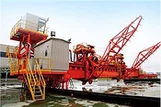
As a supplier of Discontinuous Ship Unloaders, I understand the challenges that these machines face in cold regions, especially the issue of icing. Icing can significantly affect the performance and safety of ship unloaders, leading to operational inefficiencies and potential hazards. In this blog, I will discuss the anti - icing measures for a discontinuous ship unloader in cold regions.
Understanding the Impact of Icing on Discontinuous Ship Unloaders
Discontinuous ship unloaders, such as Grab Type Ship Unloader, Query - side Container Crane, and Grab Bucket Gantry Crane, are essential for loading and unloading cargo from ships. In cold regions, icing can occur on various parts of the ship unloader, including the grab, crane arms, cables, and control systems.
Icing on the grab can increase its weight, reducing its lifting capacity and making it difficult to open and close properly. Ice on the crane arms can affect their structural integrity and flexibility, leading to potential bending or breakage. Cables can become stiff and brittle due to icing, increasing the risk of snapping. Moreover, icing on the control systems can cause malfunctions, leading to inaccurate operation and potential safety risks.
Anti - Icing Measures
1. Heating Systems
One of the most effective anti - icing measures is the installation of heating systems. There are several types of heating systems that can be used for discontinuous ship unloaders.
- Electric Heating: Electric heating elements can be installed on critical components such as the grab, crane arms, and cables. These heating elements can be controlled by a thermostat to maintain a certain temperature, preventing ice formation. For example, on the grab, electric heating pads can be attached to the surface to keep it warm. The advantage of electric heating is its high precision and easy control. However, it consumes a relatively large amount of electricity.
- Hot Air Heating: Hot air blowers can be used to direct warm air onto the parts prone to icing. This method is suitable for large - scale components such as the crane arms. The hot air can quickly melt the ice and prevent new ice from forming. The main drawback of hot air heating is that it may not be very effective in extremely cold weather, and it requires a proper ventilation system to ensure the safety of the equipment and operators.
- Steam Heating: Steam heating is another option, especially for areas where steam is readily available. Steam can be circulated through pipes installed on the ship unloader components. It has the advantage of high heat transfer efficiency. However, steam systems are more complex to install and maintain, and there is a risk of steam leakage.
2. Coatings
Applying anti - icing coatings is a cost - effective and long - term solution. These coatings can reduce the adhesion of ice to the surface of the ship unloader components.
- Hydrophobic Coatings: Hydrophobic coatings can make the surface of the components water - repellent. When water comes into contact with the coated surface, it forms droplets and rolls off easily, preventing ice from forming. These coatings are relatively easy to apply and can be used on various materials such as metal and plastic.
- Anti - Icing Additives: Some coatings contain anti - icing additives that can lower the freezing point of water on the surface. This means that water will remain in a liquid state at lower temperatures, reducing the chance of ice formation. These additives can be incorporated into paint or other coating materials.
3. Insulation
Insulating the components of the ship unloader can also help prevent icing. Insulation materials can reduce heat loss from the equipment, keeping it at a higher temperature.
- Foam Insulation: Foam insulation can be used to wrap around cables, pipes, and other components. It has good thermal insulation properties and is lightweight. Foam insulation can be easily cut and installed, and it can effectively reduce the heat transfer between the equipment and the cold environment.
- Fiberglass Insulation: Fiberglass insulation is another popular choice. It is fire - resistant and has excellent insulation performance. Fiberglass insulation can be used in areas where high - temperature resistance is required, such as near heating systems.
4. Maintenance and Monitoring
Regular maintenance and monitoring are crucial for ensuring the effectiveness of anti - icing measures.
- Visual Inspections: Operators should conduct regular visual inspections of the ship unloader to check for signs of icing. Any ice that is detected should be removed immediately. Inspections should also focus on the condition of the heating systems, coatings, and insulation to ensure they are in good working order.
- Sensor - Based Monitoring: Installing sensors on the ship unloader can provide real - time information about temperature, humidity, and ice formation. These sensors can be connected to a control system that can automatically activate the anti - icing measures when necessary. For example, if the temperature drops below a certain level and ice formation is detected, the heating system can be turned on.
5. Design Optimization
In the design stage of the discontinuous ship unloader, anti - icing considerations should be taken into account.
- Streamlined Shapes: Components should be designed with streamlined shapes to reduce the accumulation of snow and ice. For example, the crane arms can be designed with smooth surfaces and no sharp corners where ice is likely to build up.
- Drainage Systems: Adequate drainage systems should be incorporated into the design to allow water to flow away easily. This can prevent water from pooling on the surface and freezing.
Conclusion
Icing is a serious problem for discontinuous ship unloaders in cold regions. However, by implementing a combination of anti - icing measures such as heating systems, coatings, insulation, maintenance, and design optimization, the impact of icing can be effectively reduced. As a supplier of Discontinuous Ship Unloaders, we are committed to providing high - quality equipment and solutions to our customers in cold regions.


If you are interested in our Discontinuous Ship Unloaders or need more information about anti - icing measures, please feel free to contact us for procurement and negotiation. We will be happy to provide you with professional advice and support.
References
- Smith, J. (2018). Anti - icing Technologies for Marine Equipment. Journal of Marine Engineering, 25(3), 123 - 135.
- Johnson, R. (2019). The Impact of Icing on Crane Operations in Cold Regions. International Journal of Heavy Machinery, 18(2), 78 - 89.
- Brown, A. (2020). Anti - icing Coatings: A Review. Materials Science and Technology, 36(4), 567 - 580.