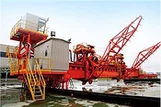
Hey there! As a supplier of Discontinuous Ship Unloaders, I'm super excited to dive into the topic of hydraulic systems used in these cool machines. Let's get started!
First off, what exactly is a discontinuous ship unloader? Well, it's a type of equipment that's used to unload cargo from ships in a non - continuous way. There are different types, like the Grab Type Ship Unloader, Query - side Container Crane, and Grab Bucket Gantry Crane. Each of these has its own unique features, but they all rely on hydraulic systems to function effectively.
Hydraulic Systems in Discontinuous Ship Unloaders
Power and Force Generation
Hydraulic systems are like the muscle of discontinuous ship unloaders. They use pressurized fluid to generate a large amount of force. In a grab - type ship unloader, for example, the hydraulic cylinders are responsible for opening and closing the grab bucket. When the hydraulic pump sends pressurized fluid into the cylinder, it moves the piston, which in turn operates the grab. This allows the grab to pick up a large amount of cargo, like coal, grains, or minerals, from the ship's hold.
The power of hydraulic systems comes from Pascal's principle. According to this principle, when pressure is applied to a confined fluid, the pressure is transmitted equally in all directions. So, a small force applied to a small - area piston can be transformed into a large force on a large - area piston. This is why hydraulic systems are so efficient in ship unloaders, as they can handle heavy loads with relatively small input forces.
Precision Control
Another great thing about hydraulic systems is their ability to provide precise control. In a query - side container crane, the hydraulic system is used to control the movement of the crane's boom and the lifting mechanism. The operator can use hydraulic valves to adjust the flow of fluid, which determines the speed and direction of the crane's movement. This precision is crucial when handling valuable or delicate cargo, like containers full of electronics or fragile goods.
For instance, when lifting a container, the hydraulic system allows the crane to lift it smoothly and place it exactly where it needs to go. The operator can also make fine - tuned adjustments to the height and angle of the container, ensuring safe and efficient unloading.
Safety Features
Safety is a top priority in ship unloading operations, and hydraulic systems play a big role in ensuring it. Most hydraulic systems in discontinuous ship unloaders are equipped with safety valves. These valves are designed to release pressure if it exceeds a certain limit, preventing damage to the system and potential accidents.
In addition, hydraulic systems can also be used for emergency stops. If there's a problem during the unloading process, the operator can activate a hydraulic emergency stop mechanism, which quickly halts the movement of the unloader. This helps to protect both the equipment and the workers on the site.
Maintenance and Reliability
Hydraulic systems in discontinuous ship unloaders are generally quite reliable, but they do require regular maintenance. The hydraulic fluid needs to be checked and changed periodically to ensure its proper functioning. Filters also need to be replaced to prevent contaminants from entering the system and causing damage.
One of the advantages of hydraulic systems is that they have fewer moving parts compared to some other types of mechanical systems. This means there are fewer components that can wear out or break down. However, when a problem does occur, it's important to have trained technicians who can diagnose and fix the issue quickly.
Types of Hydraulic Components in Ship Unloaders
Hydraulic Pumps
The hydraulic pump is the heart of the hydraulic system. It's responsible for creating the pressure needed to move the fluid through the system. There are different types of hydraulic pumps, such as gear pumps, vane pumps, and piston pumps. Each type has its own advantages and is suitable for different applications.
Gear pumps are simple and cost - effective. They're often used in smaller ship unloaders or in systems where a relatively low - pressure output is required. Vane pumps, on the other hand, are more efficient and can provide a smoother flow of fluid. Piston pumps are the most powerful and are commonly used in large - scale ship unloaders that need to handle heavy loads.
Hydraulic Cylinders
As mentioned earlier, hydraulic cylinders are used to convert the pressure of the hydraulic fluid into linear motion. They consist of a cylinder barrel, a piston, and a rod. When the pressurized fluid enters the cylinder, it pushes the piston, which moves the rod. This movement is then used to operate various parts of the ship unloader, like the grab bucket or the crane's boom.
Hydraulic Valves
Hydraulic valves are used to control the flow of fluid in the system. There are different types of valves, including directional control valves, pressure control valves, and flow control valves. Directional control valves determine the direction of the fluid flow, allowing the operator to control the movement of the unloader. Pressure control valves regulate the pressure in the system, ensuring that it doesn't exceed safe limits. Flow control valves adjust the rate of fluid flow, which affects the speed of the unloader's movement.
Challenges and Solutions in Hydraulic Systems for Ship Unloaders
Contamination
One of the biggest challenges in hydraulic systems is contamination. The hydraulic fluid can get contaminated with dirt, dust, water, or other particles. This can cause wear and tear on the components, reduce the efficiency of the system, and even lead to system failure.
To solve this problem, regular maintenance is essential. As I mentioned before, filters should be replaced regularly to remove contaminants from the fluid. In addition, the hydraulic system should be kept clean, and the fluid should be stored in a clean environment.
Temperature Management
Hydraulic systems generate heat during operation. If the temperature of the hydraulic fluid gets too high, it can cause the fluid to break down and lose its lubricating properties. This can lead to increased wear on the components and reduced system performance.


To manage the temperature, most hydraulic systems are equipped with coolers. These coolers use air or water to remove heat from the fluid. The operator also needs to monitor the temperature of the fluid and make sure it stays within the recommended range.
Conclusion
In conclusion, hydraulic systems are an essential part of discontinuous ship unloaders. They provide the power, precision, and safety needed for efficient and reliable cargo unloading. Whether it's a grab - type ship unloader, a query - side container crane, or a grab bucket gantry crane, hydraulic systems play a crucial role in making these machines work.
If you're in the market for a discontinuous ship unloader or need to upgrade your existing equipment, I'd love to have a chat with you. Our company has a lot of experience in providing high - quality discontinuous ship unloaders with top - notch hydraulic systems. We can offer customized solutions to meet your specific needs. So, don't hesitate to reach out for a procurement discussion. Let's work together to make your ship - unloading operations more efficient and successful!
References
- "Hydraulic Systems Handbook" by E. O. Doebelin
- "Ship Unloading Technology" by various authors in the maritime engineering field