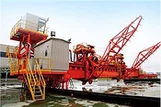
As a seasoned supplier of Mobile Ship Loaders, I'm excited to delve into the technical specifications that make these machines indispensable in the maritime and bulk handling industries. Mobile Ship Loaders are engineered to efficiently transfer various bulk materials, such as coal, grains, ores, and fertilizers, from storage facilities to ships. Their mobility, flexibility, and high - performance capabilities are key features that set them apart from traditional ship loading systems.
Structural Design
The structural design of a Mobile Ship Loader is a critical aspect that determines its stability, durability, and operational efficiency. Most Mobile Ship Loaders feature a robust steel structure that can withstand harsh marine environments and heavy loads. The main frame is typically designed to support the conveyor system, boom, and other components.
The boom, which is the extendable arm of the loader, is a crucial part of the structure. It is usually made of high - strength steel and is designed to be able to reach different parts of the ship's cargo hold. The length of the boom can vary depending on the specific requirements of the port and the size of the ships being loaded. For example, some Mobile Ship Loaders have booms that can extend up to 50 meters or more.
The undercarriage of the Mobile Ship Loader is another important structural element. It is designed to provide mobility and stability. The undercarriage often consists of large - diameter wheels or tracks, depending on the type of terrain and the load - bearing requirements. Tracks are preferred in soft or uneven terrains, as they distribute the weight of the loader more evenly and provide better traction.
Conveyor System
The conveyor system is the heart of the Mobile Ship Loader. It is responsible for transporting the bulk materials from the storage area to the ship. The conveyor system typically consists of a series of belts, pulleys, and idlers.


The belt is the most visible part of the conveyor system. It is made of a durable rubber or synthetic material and is designed to withstand the abrasion and impact of the bulk materials. The width of the belt can vary depending on the type and volume of the materials being transported. For example, wider belts are used for handling large - volume materials such as coal or ores.
Pulleys are used to guide and tension the belt. They are usually made of steel and are designed to rotate smoothly. Idlers, on the other hand, are used to support the belt and keep it in place. They are spaced at regular intervals along the length of the conveyor to ensure proper belt alignment and reduce friction.
The conveyor system also includes a drive unit, which provides the power to move the belt. The drive unit typically consists of an electric motor, a gearbox, and a coupling. The motor provides the rotational force, which is then transmitted to the belt through the gearbox and coupling.
Control System
The control system of a Mobile Ship Loader is designed to ensure safe and efficient operation. It allows the operator to control the movement of the loader, the speed of the conveyor, and the flow of the bulk materials.
Most Mobile Ship Loaders are equipped with a state - of - the - art PLC (Programmable Logic Controller) - based control system. The PLC can be programmed to perform a variety of functions, such as automatic loading sequences, speed control, and fault detection.
The control system also includes a human - machine interface (HMI), which allows the operator to interact with the loader. The HMI typically consists of a touchscreen display that provides real - time information about the loader's operation, such as the position of the boom, the speed of the conveyor, and the status of the sensors.
In addition to the local control system, many Mobile Ship Loaders can also be controlled remotely. This allows for greater flexibility and convenience, especially in large ports where the operator may need to monitor and control multiple loaders from a central location.
Safety Features
Safety is of utmost importance in the operation of Mobile Ship Loaders. These machines are equipped with a variety of safety features to protect the operator, the equipment, and the environment.
One of the most important safety features is the emergency stop button. This button can be pressed at any time to immediately stop the operation of the loader in case of an emergency.
The loader is also equipped with a variety of sensors, such as limit switches, proximity sensors, and load sensors. Limit switches are used to prevent the boom from moving beyond its safe operating range. Proximity sensors are used to detect the presence of objects or people in the vicinity of the loader, and load sensors are used to monitor the weight of the materials being loaded to prevent overloading.
In addition, Mobile Ship Loaders are often equipped with a fire suppression system. This system can detect and extinguish fires in the conveyor system or other parts of the loader to prevent damage and ensure the safety of the operator.
Types of Mobile Ship Loaders
There are several types of Mobile Ship Loaders available in the market, each with its own unique technical specifications and applications.
- Fixed Swing Ship Loader: The Fixed Swing Ship Loader is designed to swing around a fixed point. This type of loader is suitable for ports where the ships are berthed at a fixed location. It offers a high degree of accuracy and efficiency in loading operations.
- Fixed Bulk Ship Loader: The Fixed Bulk Ship Loader is designed for handling large - volume bulk materials. It has a large - capacity conveyor system and a robust structure to handle the heavy loads. This type of loader is commonly used in ports that handle coal, ores, and other bulk commodities.
- Arc Track Ship Loader: The Arc Track Ship Loader moves along an arc - shaped track. This allows for greater flexibility in reaching different parts of the ship's cargo hold. It is suitable for ports with limited space or where the ships are berthed at different angles.
Capacity and Throughput
The capacity and throughput of a Mobile Ship Loader are important factors to consider when choosing the right machine for a specific application. The capacity of a loader refers to the maximum amount of materials that it can handle per hour. This is usually measured in tons per hour (t/h).
The throughput of a loader depends on several factors, such as the type of materials being handled, the speed of the conveyor system, and the efficiency of the loading process. For example, a Mobile Ship Loader with a high - speed conveyor system and a well - designed loading mechanism can achieve a higher throughput than a loader with a slower conveyor system.
In general, the capacity of Mobile Ship Loaders can range from a few hundred tons per hour to several thousand tons per hour, depending on the size and design of the machine.
Maintenance and Serviceability
Proper maintenance and serviceability are essential for the long - term performance and reliability of Mobile Ship Loaders. These machines are designed to be easy to maintain, with access points provided for inspection, lubrication, and replacement of parts.
Regular maintenance tasks include checking the belts for wear and tear, lubricating the moving parts, and inspecting the electrical and hydraulic systems. Most Mobile Ship Loaders come with a maintenance manual that provides detailed instructions on how to perform these tasks.
In addition, our company offers comprehensive service and support for all our Mobile Ship Loaders. Our team of experienced technicians can provide on - site maintenance, repair, and training services to ensure that your loader operates at its best.
Conclusion
Mobile Ship Loaders are highly sophisticated machines that play a crucial role in the efficient loading of bulk materials onto ships. Their technical specifications, including structural design, conveyor system, control system, safety features, and capacity, are carefully engineered to meet the diverse needs of the maritime and bulk handling industries.
Whether you are looking for a Fixed Swing Ship Loader, a Fixed Bulk Ship Loader, or an Arc Track Ship Loader, we have the right solution for you. If you are interested in learning more about our Mobile Ship Loaders or would like to discuss your specific requirements, please do not hesitate to contact us for a detailed consultation and procurement discussion.
References
- Handbook of Bulk Materials Handling, Second Edition
- Ship Loading and Unloading Equipment: Design and Operation Guide