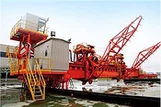
Hey there! As a supplier of Mobile Bulk Ship Loaders, I often get asked about how these nifty machines can adjust to different ship heights. It's a crucial question, especially considering the wide variety of vessels out there, each with its own unique specifications. So, let's dive right in and explore the ins and outs of this process.
First off, let's understand what a Mobile Bulk Ship Loader is. It's a piece of equipment designed to efficiently transfer bulk materials, like coal, grain, or ore, from a storage facility onto a ship. And since ships come in all shapes and sizes, with varying freeboard heights (the distance from the waterline to the deck), the loader needs to be flexible.
One of the most common ways a Mobile Bulk Ship Loader adjusts to different ship heights is through its telescopic boom. Think of it like a big, mechanical arm that can extend and retract. When a ship with a higher freeboard pulls up, the operator can simply extend the boom to reach the deck. Conversely, for a ship with a lower freeboard, the boom can be retracted to avoid over - reaching. This telescopic feature allows for a wide range of height adjustments, making it suitable for most ships in the market.
Another important component is the hoist system. The hoist is responsible for raising and lowering the boom. It's like an elevator for the loader's arm. Using a powerful motor and a system of cables or chains, the hoist can precisely control the vertical position of the boom. When a ship arrives, the operator can use the hoist controls to raise or lower the boom until it's at the right height for loading. This system is incredibly accurate, ensuring that the material is loaded safely and efficiently.
Now, let's talk about the different types of Mobile Bulk Ship Loaders and how they handle height adjustments. We have the Linear Swing Ship Loader. This type of loader has a boom that can move in a linear fashion along a track. In addition to the telescopic and hoist functions, the linear movement allows for even more flexibility. If a ship is positioned at an angle or if there are multiple hatches at different heights on the deck, the linear swing feature enables the loader to reach each one easily. The operator can move the loader along the track and adjust the boom height as needed, ensuring comprehensive coverage of the ship's loading areas.
Then there's the Arc Track Ship Loader. As the name suggests, this loader moves along an arc - shaped track. Similar to the linear swing loader, it offers the ability to adjust the boom height using the telescopic and hoist systems. The arc - shaped movement, however, provides a different kind of flexibility. It's particularly useful for ships that are docked in a curved or irregularly shaped berth. The loader can follow the arc of the track and still adjust the boom height to match the ship's deck, making it a versatile option for various docking scenarios.
In addition to these mechanical adjustments, modern Mobile Bulk Ship Loaders are often equipped with advanced sensor technology. These sensors can detect the height of the ship's deck in real - time. They work by emitting signals, such as laser or ultrasonic waves, and measuring the time it takes for the signals to bounce back. Based on this data, the loader's control system can automatically adjust the boom height to the optimal position. This not only saves time but also reduces the risk of human error, ensuring a more efficient and accurate loading process.
Moreover, the control systems on these loaders are highly sophisticated. They allow the operator to input the ship's specifications, such as its freeboard height, length, and the location of the hatches. Once this information is entered, the system can calculate the best way to position the boom for loading. It can also provide visual and auditory feedback to the operator, guiding them through the height adjustment process step by step.
Maintenance also plays a crucial role in ensuring that the loader can effectively adjust to different ship heights. Regular inspections of the telescopic boom, hoist system, and sensors are essential. Any signs of wear and tear, such as frayed cables or malfunctioning sensors, need to be addressed immediately. By keeping the equipment in top - notch condition, we can guarantee that it will perform reliably when it comes to height adjustments.
So, if you're in the market for a Mobile Bulk Ship Loader, you can see that there are multiple ways these machines can adapt to different ship heights. Whether it's through the telescopic boom, hoist system, linear or arc - track movement, or advanced sensor technology, they offer a high degree of flexibility and precision.
If you're interested in learning more about our Mobile Bulk Ship Loaders or have any questions regarding how they can meet your specific needs, don't hesitate to reach out. We're here to help you find the perfect solution for your bulk material loading requirements. Contact us today to start a conversation about your project and see how our loaders can make your operations more efficient.


References
- Industry standards and guidelines for bulk ship loading equipment
- Technical manuals of Mobile Bulk Ship Loaders
- Case studies on the use of Mobile Bulk Ship Loaders in different ports around the world