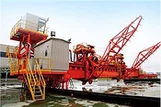
Hey there! I'm from a company that supplies Arc Track Ship Loaders, and today I'm gonna talk about how the wear-resistant coating of an Arc Track Ship Loader is applied.
First off, let's understand why wear-resistant coatings are so important for Arc Track Ship Loaders. These ship loaders are constantly in contact with all sorts of bulk materials like coal, ore, and grains. The continuous loading and unloading operations cause a lot of abrasion and wear on the equipment's surfaces. Without a proper wear-resistant coating, the parts of the ship loader would wear out quickly, leading to frequent maintenance, downtime, and increased costs.
Now, let's dive into the application process. The first step is surface preparation. This is a crucial stage because a well-prepared surface ensures better adhesion of the wear-resistant coating. We start by cleaning the surface of the Arc Track Ship Loader thoroughly. Any dirt, grease, rust, or old paint needs to be removed. We usually use methods like sandblasting or chemical cleaning. Sandblasting is a popular choice as it not only removes the contaminants but also creates a rough surface profile. This rough surface gives the coating something to grip onto, enhancing the adhesion.
After the surface is clean, we inspect it for any defects such as cracks or pits. If there are any, we repair them before applying the coating. For small cracks, we might use a filler material that is compatible with the coating. Once the repairs are done, the surface is ready for the next step.
The next stage is the actual coating application. There are different types of wear-resistant coatings available, and the choice depends on various factors such as the type of material the ship loader will handle, the operating conditions, and the budget. Some common types of coatings include ceramic coatings, polymer coatings, and metal-based coatings.
Ceramic coatings are known for their excellent hardness and wear resistance. They can withstand high temperatures and are very effective in protecting against abrasion. To apply a ceramic coating, we usually use a spraying technique. We mix the ceramic particles with a binder and spray it onto the prepared surface using a specialized spray gun. The spray gun needs to be held at the correct distance and angle to ensure an even coating thickness. The thickness of the ceramic coating can vary depending on the requirements, but typically it ranges from a few hundred microns to a few millimeters.
Polymer coatings, on the other hand, are more flexible and have good chemical resistance. They are often used in applications where there is a need for some degree of flexibility. Polymer coatings can be applied using a brush, roller, or spray. If we use a brush or roller, we need to make sure that the coating is applied in thin, even layers. This helps to avoid air bubbles and ensures a smooth finish. When using a spray, we need to control the spray pattern and the pressure to get an even coating.
Metal-based coatings are also a popular choice, especially for applications where high strength and wear resistance are required. They can be applied using processes like thermal spraying. In thermal spraying, the metal is heated to a molten or semi-molten state and then sprayed onto the surface. This creates a strong bond between the coating and the substrate.
Once the coating is applied, it needs to cure. Curing is the process by which the coating hardens and develops its full properties. The curing time depends on the type of coating. Some coatings cure at room temperature, while others require heat treatment. For example, some polymer coatings might need to be baked in an oven at a specific temperature for a certain period of time. During the curing process, it's important to keep the coated surface clean and protected from any damage.
After the coating has cured, we conduct a quality inspection. We check the coating thickness using a coating thickness gauge. The thickness should be within the specified range. We also look for any signs of defects such as cracks, bubbles, or unevenness. If there are any issues, we might need to touch up the coating or even reapply it in some cases.
Another important aspect of applying the wear-resistant coating is safety. The materials used in the coatings can be hazardous, so we need to take proper safety precautions. Workers should wear protective clothing, gloves, and masks. The coating application area should be well-ventilated to prevent the inhalation of fumes.


When it comes to maintaining the wear-resistant coating, regular inspections are necessary. We need to check the coating for any signs of wear or damage over time. If we notice any areas where the coating is starting to wear off, we can apply a touch-up coating to prevent further damage.
Now, if you're in the market for a ship loader, we offer different types of ship loaders apart from the Arc Track Ship Loader. You can check out our Mobile Bulk Ship Loader and Fixed Swing Ship Loader on our website. And of course, if you're specifically interested in the Arc Track Ship Loader, we've got you covered.
If you have any questions about the wear-resistant coating application or are interested in purchasing one of our ship loaders, don't hesitate to get in touch. We're here to help you find the best solution for your needs.
References:
- "Wear Coatings for Industrial Applications" by XYZ Publishing
- "Coating Technology Handbook" by ABC Publications