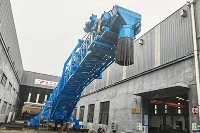
Hey there! As a supplier of Mobile Bulk Ship Loaders, I'm super stoked to chat about the braking systems of these awesome machines. Mobile Bulk Ship Loaders are crucial in the shipping industry, helping to load all sorts of bulk materials onto ships efficiently. And a good braking system is like the safety net that keeps everything in check.
First off, let's understand what a Mobile Bulk Ship Loader is. You can check out more details about it Mobile Bulk Ship Loader. These loaders are designed to move around and load bulk materials such as coal, grain, and ore onto ships. They need to be reliable and safe, and that's where the braking systems come in.
There are a few different types of braking systems used in Mobile Bulk Ship Loaders. Let's start with the mechanical braking system. This is one of the most basic and commonly used types. It works by using friction to slow down or stop the movement of the loader. Mechanical brakes usually consist of brake pads or shoes that press against a rotating part, like a brake drum or disc. When the operator applies the brakes, the pads or shoes create friction, which in turn slows down the loader.
One of the advantages of mechanical brakes is their simplicity. They're relatively easy to understand and maintain. However, they also have some limitations. For example, they can wear out over time, especially if they're used frequently. And in some cases, they might not be able to provide enough braking force, especially for larger and heavier loaders.


Another type of braking system is the hydraulic braking system. Hydraulic brakes use fluid pressure to transmit the braking force. When the operator presses the brake pedal, it activates a hydraulic pump, which then sends pressurized fluid to the brake calipers or cylinders. The fluid pressure causes the brake pads to press against the brake discs or drums, slowing down the loader.
Hydraulic brakes have several advantages. They can provide a lot of braking force, even for large and heavy loaders. They're also more responsive than mechanical brakes, which means they can stop the loader more quickly. However, hydraulic brakes are more complex than mechanical brakes, and they require more maintenance. If there's a leak in the hydraulic system, it can cause the brakes to fail, which is a serious safety issue.
Electromagnetic braking systems are also used in some Mobile Bulk Ship Loaders. These brakes work by using an electromagnetic field to create a braking force. When the operator activates the brakes, an electric current is sent to an electromagnet, which creates a magnetic field. This magnetic field then interacts with a metal disc or drum, creating a braking force.
Electromagnetic brakes have some unique advantages. They're very fast and responsive, which means they can stop the loader almost instantly. They're also very reliable, as they don't have any moving parts that can wear out. However, they can be more expensive than other types of brakes, and they require a power source to operate.
In addition to the main braking systems, Mobile Bulk Ship Loaders also have secondary or emergency braking systems. These systems are designed to provide an extra layer of safety in case the primary braking system fails. For example, some loaders have a parking brake, which is used to keep the loader stationary when it's not in use. The parking brake is usually a mechanical brake that can be engaged manually.
Another type of emergency braking system is the anti-lock braking system (ABS). ABS is designed to prevent the wheels from locking up during braking, which can cause the loader to skid. ABS works by monitoring the speed of the wheels and adjusting the braking force accordingly. If the system detects that a wheel is about to lock up, it will reduce the braking force on that wheel, allowing it to continue rotating.
Now, let's talk about the importance of choosing the right braking system for your Mobile Bulk Ship Loader. The type of braking system you choose will depend on several factors, such as the size and weight of the loader, the type of materials it will be loading, and the operating conditions. For example, if you're using a loader to load heavy materials, you might need a braking system that can provide a lot of braking force, such as a hydraulic or electromagnetic brake.
It's also important to consider the maintenance requirements of the braking system. Some braking systems require more maintenance than others, so you'll need to factor in the cost and time required for maintenance when choosing a system. Additionally, you'll want to make sure that the braking system is easy to access and repair, in case something goes wrong.
As a supplier of Mobile Bulk Ship Loaders, we offer a range of braking systems to meet the needs of our customers. Whether you're looking for a mechanical, hydraulic, or electromagnetic braking system, we can help you find the right one for your loader. We also provide maintenance and repair services to ensure that your braking system is always in top condition.
If you're in the market for a Mobile Bulk Ship Loader or if you need to replace the braking system on your existing loader, we'd love to hear from you. We can provide you with more information about our products and services, and we can help you choose the right braking system for your needs. Just reach out to us, and we'll be happy to assist you.
In addition to Mobile Bulk Ship Loaders, we also offer Fixed Bulk Ship Loader and Arc Track Ship Loader. These loaders have their own unique features and braking systems, and we can help you choose the right one for your specific application.
So, if you're looking for a reliable and efficient braking system for your Mobile Bulk Ship Loader, don't hesitate to contact us. We're here to help you make the right choice and ensure that your loader is safe and reliable.
References:
- General knowledge of ship loader braking systems from industry experience.